What is drawdown in trading?
- Written by: admin
- Category: Uncategorized
- Published: October 17, 2026
Understanding Drawdown in Trading
In the introduction to the trading world, individuals quickly learn the significance of comprehending various fundamental concepts and terminologies. These concepts are essential for making informed decisions in an environment characterized by high volatility and potential financial risks. One such critical term that often surfaces in trading discussions is drawdown. Understanding and interpreting this concept is pivotal for traders at all experience levels, as it directly influences how traders manage risks associated with their trading activities.
What is Drawdown?
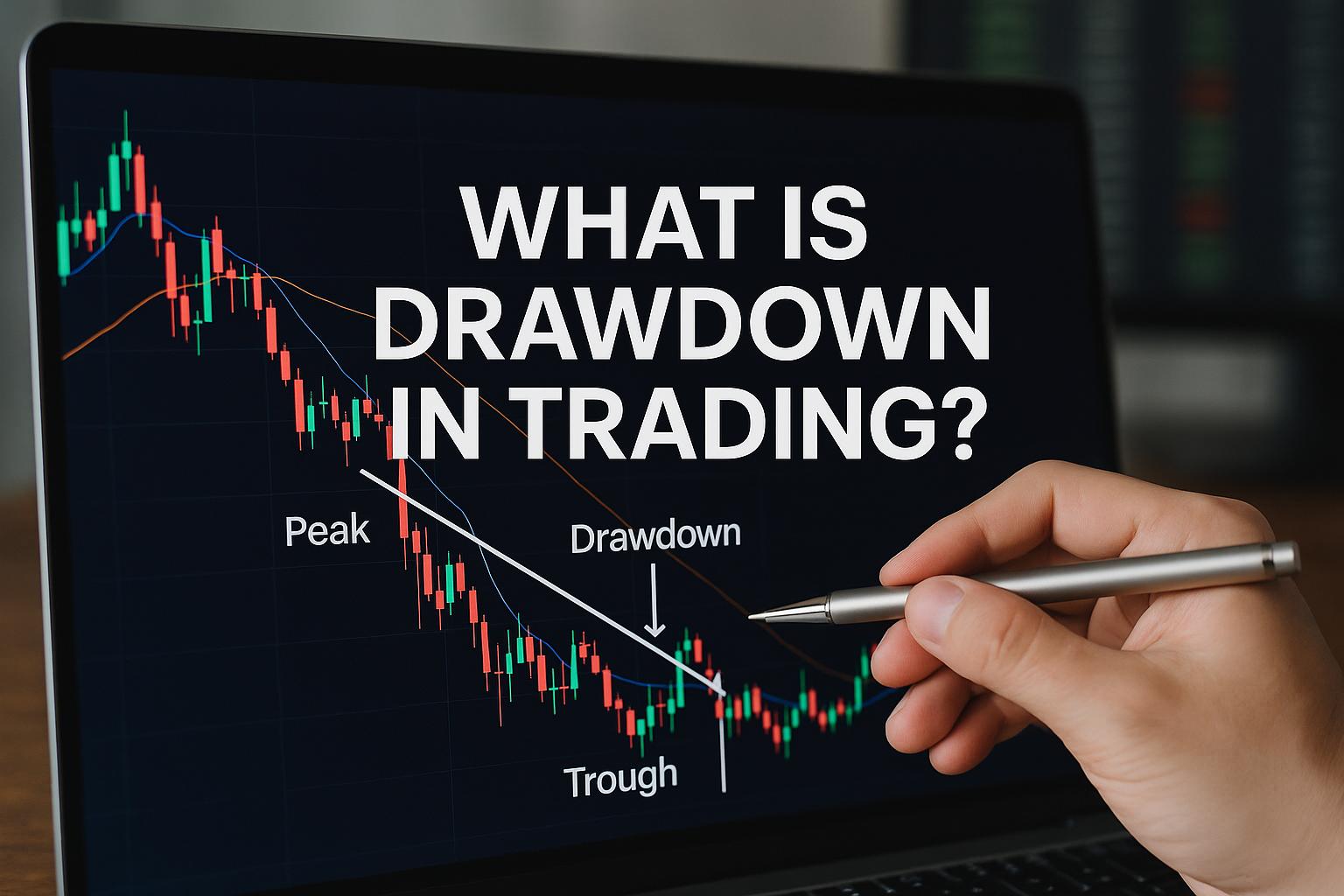
In trading contexts, a drawdown signifies the reduction in an account’s capital. Technically, it represents the difference observed between the peak and trough of an account’s balance over a specific time frame. This metric shows how much the account’s balance has decreased from a historical high point before it rebounds to a comparable level. Essentially, traders use drawdown to evaluate the volatility and potential risks a trading account might face in the financial markets.
Calculating Drawdown
The calculation of drawdown involves a straightforward process. Initially, traders identify the account’s peak equity curve, the highest value attained by the account. Following is identifying the lowest point after this significant checkpoint, termed as the trough. The drawdown is mathematically represented as a percentage reduction from this peak value. For illustration purposes, consider an account starting at $10,000, which falls to $8,000 before making a recovery. In this scenario, the experienced drawdown would be 20%.
Formula:
\[ \text{Drawdown (\%)} = \left( \frac{\text{Peak Value} – \text{Trough Value}}{\text{Peak Value}} \right) \times 100 \]
This formula is instrumental in quantifying the extent of loss, offering an empirical measure that traders rely on to devise risk management strategies aligned with their financial goals.
Types of Drawdowns
When discussing drawdowns, it is important to recognize that there are different types, based on their specific attributes like duration and magnitude. Understanding these variations helps in shaping appropriate trading strategies. Typically, drawdowns can either be short-lived and relatively shallow, causing minimal distress and financial impact, or they might be extended and profound, severely affecting trading equity and psychology. The strategy and emotional resilience of the trader often determine their effective handling of these situations.
The Importance of Managing Drawdown
Drawdown is not merely a numerical metric; it plays a substantial role in influencing trading psychology and outlining risk management practices. A significant drawdown can challenge a trader’s mental fortitude, often leading to impulsive, regretful decision-making, thus emphasizing the importance of calculated risk management. Implementing effective risk strategies, such as establishing stop-loss orders and strategic position sizing, can efficiently curb the destructive impacts of drawdowns.
Risk management tools serve as shields, equipping traders to counteract the adversities posed by drawdowns. Elements like stop-loss orders function as safety nets, curtailing potential losses by automatically closing a losing position at a pre-determined price. Position sizing, another vital technique, involves adjusting the amount of capital allocated to a given trade based on the trader’s risk tolerance and current market conditions.
Those who aspire to refine their approach to drawdowns and enhance overall trading performance can access abundant resources and expert guidance. Exploring specialized websites or platforms like Investopedia can offer in-depth insights into optimizing trading methodologies and strategies, potentially imparting knowledge on tactical interventions and evolving market trends.
Understanding drawdown and mastering its management holds substantial weight in determining long-term success within trading arenas. By maintaining an informed perspective and mitigating drawdowns appropriately, traders not only stabilize their financial footing but also enhance resilience against inevitable market fluctuations. In sum, keeping drawdowns in check is paramount, ensuring the sustainability of trading practices in dynamic market environments.
This article was last updated on: October 17, 2026